
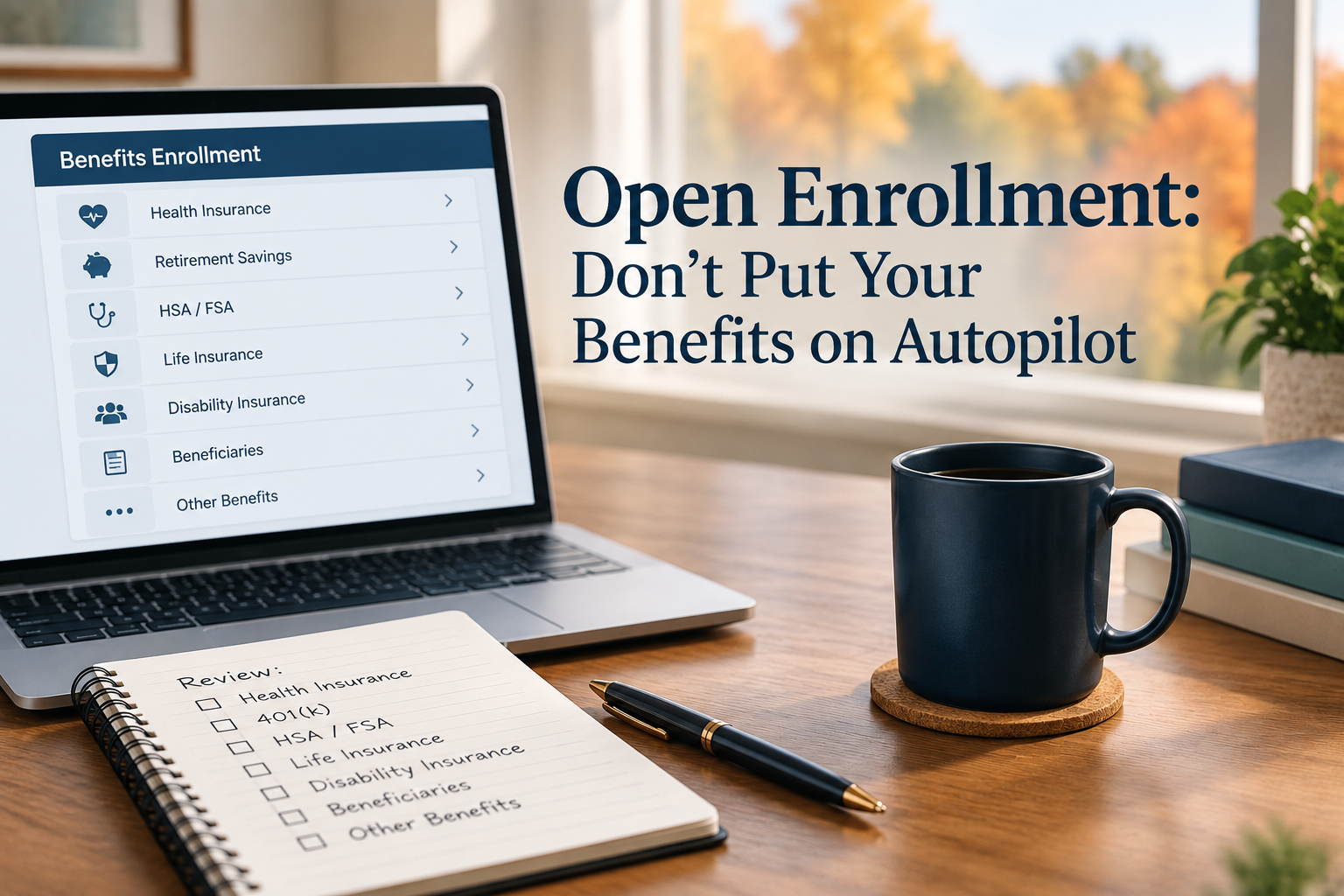
Every fall, millions of employees are asked to make decisions about their benefits for the coming year.
And I suspect a lot of people handle it the same way.
They log into the benefits portal, see what changed, keep most of the elections they already have and click submit.
I understand why. Open enrollment can feel more like an HR requirement than a financial planning decision. But when you look at everything you may be choosing—health insurance, retirement contributions, life insurance, disability coverage, health savings accounts and other benefits—there can be a lot of money tied to those decisions.
More importantly, your life may have changed even if your employer's benefits haven't.
That's why I think open enrollment is a good time to step back and do an annual benefits review rather than simply putting last year's elections on autopilot.
Start With What Changed in Your Life
Before comparing deductibles or insurance premiums, I'd start somewhere else:
What's different from a year ago?
Maybe you got married or divorced. Maybe you had a child. Your spouse may have changed jobs. Your income could be substantially different. You may be helping an aging parent, approaching retirement or dealing with different healthcare needs.
Sometimes nothing has changed in the benefits package, but something important has changed in your financial life.
That's the lens I would use when reviewing the rest of your elections.
Don't Choose Health Insurance Based Only on the Premium
The monthly premium is probably the easiest number to compare when you're looking at health insurance options.
It isn't necessarily the most important one.
You also need to consider the deductible, coinsurance, co-pays, prescription coverage and maximum out-of-pocket costs. Then think about how your family actually uses healthcare.
Someone with relatively few medical expenses may look at the options very differently than a family expecting surgery, regular specialist visits or expensive prescriptions.
There isn't one health plan that's right for everyone. The objective is to understand the tradeoffs rather than automatically choosing the plan with the lowest premium—or simply keeping the same plan because that's what you had last year.
An HSA Can Be More Than a Medical Spending Account
If one of your choices is an HSA-eligible health plan, the Health Savings Account deserves some additional attention.
HSAs have an unusual combination of tax advantages. Eligible contributions can receive favorable tax treatment, earnings can grow tax-free, and withdrawals used for qualified medical expenses can also be tax-free.
Unlike many Flexible Spending Accounts, money in an HSA doesn't disappear at the end of the year. The balance remains in the account and stays with you if you change employers.
That creates an interesting choice.
You can use an HSA to pay current medical bills, but someone who has sufficient cash flow may instead choose to leave some of that money invested for future healthcare expenses.
For 2026, the HSA contribution limit is $4,400 for self-only coverage and $8,750 for family coverage. Those limits include eligible employer contributions, so make sure you understand what your employer is contributing before determining your own amount.
An FSA can also be valuable, but it works differently. In particular, unused FSA dollars can generally be forfeited, although some employer plans allow a limited carryover or grace period.
The important point is not that an HSA is always better than an FSA. It's that these accounts shouldn't be treated as interchangeable.
Revisit Your Retirement Elections
Your 401(k) election is another decision that's easy to leave unchanged year after year.
I'd look at it again.
Start with the employer match. Make sure you understand the formula and whether anything has changed.
Then look at your own contribution.
If your income increased during the year, is it time to increase the percentage you're saving? If you're approaching retirement, should you be contributing more aggressively? If your employer offers both traditional and Roth contributions, does the way you're splitting contributions still make sense for your tax situation?
For 2026, employees can generally defer up to $24,500 into a 401(k), 403(b) or governmental 457 plan. Workers age 50 and older may be eligible for additional catch-up contributions, with a higher catch-up limit applying at ages 60 through 63.
You don't necessarily need to maximize every available account. But I wouldn't let an election made several years ago determine how much you're saving today simply because no one ever changed it.
Employer Life Insurance May Not Be Your Entire Life Insurance Plan
Employer-provided life insurance is convenient, and some companies provide a base amount at little or no cost.
The more important question is whether the amount is actually appropriate.
If other people depend on your income, consider what would happen financially if that income suddenly disappeared.
Would your spouse be able to maintain the household? What debts would remain? What about college funding? How much would your family need, and for how long?
There's another consideration with employer coverage: your job and your insurance can sometimes be connected. If you leave the company, the coverage may change or disappear depending on the plan.
Employer life insurance can be a useful piece of your protection strategy. Just don't assume that whatever amount appears on your benefits screen is automatically the amount your family needs.
Don't Overlook Disability Insurance
People spend a lot of time thinking about protecting assets.
Sometimes we spend much less time thinking about protecting the income that allowed us to accumulate those assets in the first place.
That's why disability coverage deserves attention during a benefits review, particularly for households that depend heavily on one person's earnings.
Look at how much income the policy would replace, how long you would have to wait before benefits begin, how long benefits could last and how the policy defines disability.
For someone with a specialized occupation, the details can become even more important.
The question isn't simply whether you checked the disability insurance box. It's whether the coverage would actually protect your household if your ability to earn an income changed.
Check Your Beneficiaries
This might be the easiest item on the entire list, but it can also be one of the most important.
Look at the beneficiary designations on your retirement accounts and employer-provided life insurance.
Then ask whether they still reflect what you want.
Marriage, divorce, births, deaths and changes to an estate plan are all good reasons to review beneficiaries. Even without a major life event, I think it's worth checking them periodically.
It takes a few minutes and can prevent a much larger problem later.
Look at the Benefits You Usually Skip
Many employers now offer a long list of voluntary benefits beyond traditional health insurance and a retirement plan.
Depending on the company, you might see:
- Dependent-care benefits
- Legal plans
- Employee stock purchase programs
- Supplemental life insurance
- Accident or critical illness coverage
- Identity-theft protection
- Long-term disability coverage
- Other voluntary benefits
Some may be useful. Others may not be particularly valuable for your situation.
The point isn't to sign up for everything your employer offers. It's to understand what you're being offered and make an intentional decision.
Your Benefits Are Part of Your Financial Plan
Open enrollment is easy to treat as paperwork.
I think it's more useful to look at it as an annual financial planning checkpoint.
Your health insurance affects your cash flow and financial risk. Your HSA can affect both taxes and long-term savings. Your retirement elections influence how much you're accumulating for the future. Life and disability insurance protect the financial plan if something goes wrong. Beneficiary designations help determine where assets ultimately go.
Those aren't separate decisions.
They're pieces of the same financial picture.
So before you click "keep my current elections" this fall, spend a little time looking at what has changed—not just in your employer's benefits package, but in your own life.
An extra hour reviewing your benefits today could influence financial decisions you'll live with for much longer than the next twelve months.
This content is developed from sources believed to be providing accurate information. It may not be used for the purpose of avoiding any federal tax penalties. Please consult legal or tax professionals for specific information regarding your individual situation. The opinions expressed and material provided are for general information, and should not be considered a solicitation for the purchase or sale of any security.