
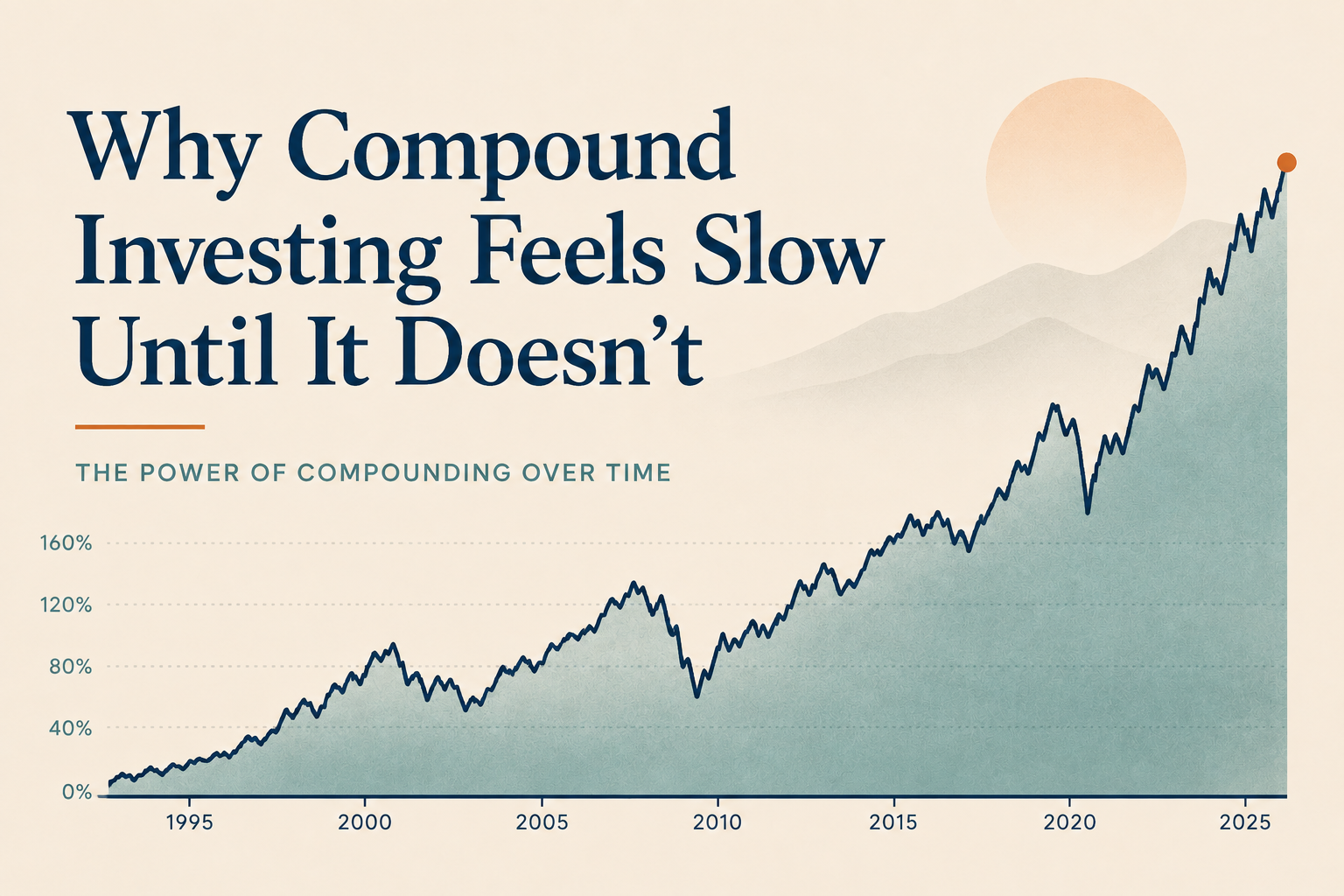
One of the things I've noticed over the years as a financial advisor is how differently investment growth feels depending on how much someone has accumulated. Early on, progress can feel painfully slow. You save, contribute to retirement accounts and hopefully earn investment returns, yet the balance doesn't always seem to move very much.
Then something changes.
I see it when clients move through different asset levels. The lower levels often take the longest to get through. But somewhere around $400,000 to $450,000, I frequently notice portfolios starting to move through the next levels much faster.
There isn't anything magical about $400,000. It's simply where compounding can start becoming much more noticeable in actual dollars.
When your portfolio is smaller, saving is still the primary engine of wealth creation.
The First Few Hundred Thousand Can Be the Hardest
When your portfolio is smaller, saving is still the primary engine of wealth creation.
A $10,000 contribution to a $50,000 portfolio increases the amount invested by 20%. That same $10,000 added to a $450,000 portfolio increases it by only about 2.2%.
Meanwhile, even a 7% return on $450,000 represents $31,500 of potential investment growth.
As the portfolio grows, the relationship between contributions and investment returns gradually changes. Eventually, a year's investment growth can exceed a year's contributions. With enough capital and enough time, it can potentially exceed several years of contributions.
That's when compounding really starts to become visible.
Why Compounding Accelerates
Compounding means you're not only earning potential returns on the money you originally invested. Previous gains become part of the capital that can generate future gains.
If $100,000 earns 10%, it becomes $110,000. Another 10% return is now being earned on $110,000, not the original $100,000.
Keep repeating that process and the dollars involved become increasingly meaningful.
The return doesn't have to get better. The portfolio simply has a larger base to work from.
That's why investment growth isn't a straight line.
Compounding Still Requires Patience
None of this means investment portfolios move smoothly upward. Markets decline. Returns vary from year to year. Investors add and withdraw money. Taxes, fees and investment choices all affect actual results.
But the underlying principle remains the same. The larger the amount of capital you have working for you, the larger the potential dollar impact of a given percentage return.
The Part We Usually Don't See
We tend to notice wealth once it becomes large. We see the million-dollar portfolio. We don't see all the years when it was $50,000, then $100,000, then $200,000.
We don't see the contributions that built the original capital or the years when an investor wondered whether they were making much progress at all. That's why wealth can sometimes look like it happened suddenly.
Usually, it didn't.
It was years of saving followed by years of compounding on an increasingly larger base. The early years can feel slow because they are. But they're also building the capital that can make the later years move surprisingly fast.