
Introduction: The Retirement Income Problem No One Names
Much of today’s conversations around retirement income centers on how much retirees can safely withdraw from their portfolios. Concepts like safe withdrawal rates and required minimum distributions (RMDs) dominate the discussion, often framed as competing constraints retirees must carefully balance.
What’s rarely stated outright is the assumption behind most of this advice: that retirement income must come from selling investments.
When that assumption is baked into a plan, market volatility becomes a real risk—not because prices move, but because retirees are forced to act when markets are down. This is where anxiety around withdrawal rates, RMDs, and market timing begins.
Why Safe Withdrawal Rates and RMDs Feel at Odds
Safe withdrawal rates are designed to help portfolios last. They attempt to balance spending needs with long-term sustainability, often assuming a steady, inflation-adjusted withdrawal funded by portfolio liquidation.
RMDs, on the other hand, are a tax rule. They require retirees to withdraw increasing percentages from tax-deferred accounts as they age, regardless of market conditions.
The tension arises when both are applied to portfolios that depend on selling assets for income. In down markets, retirees may be required to sell more shares at lower prices—exactly when they would prefer not to.
This isn’t a flaw in withdrawal math or tax law. It’s a portfolio design issue.
Why Market Volatility Doesn’t Have to Hurt your plan
Volatility by itself is not the real risk in retirement. Forced decision-making is.
When income depends on selling investments:
- Market declines reduce portfolio values
- Required withdrawals remain fixed or increase
- Investors are forced to sell at unfavorable times
This dynamic is often labeled sequence-of-returns risk. In theory, it’s a math problem. In reality, it’s a behavioral one.
It creates stress, second-guessing, and—too often—abandoned plans.
A Different Starting Point: Income First
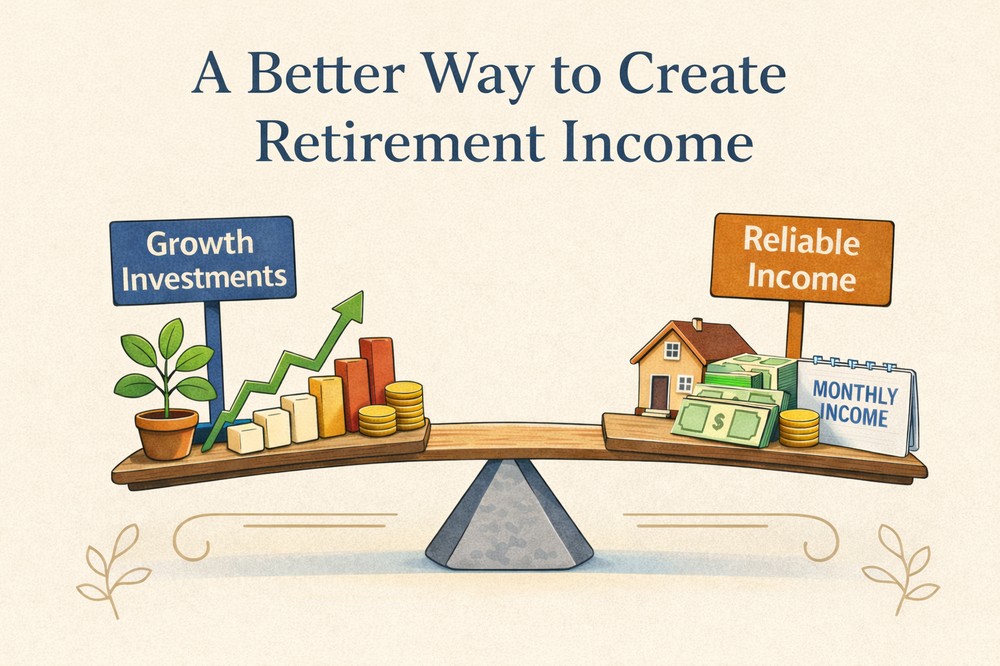
There is another way to approach retirement income planning—one that begins with cash flow rather than liquidation.
In income-focused portfolios:
- Cash flow is generated by the portfolio itself
- Income is planned, not improvised
- Market prices affect valuation, not monthly paychecks
Income-first does not mean maximizing yield or abandoning growth. It means separating cash flow from market timing.
When income is sufficient, market volatility becomes background noise rather than a lifestyle threat.
What This Changes About RMDs
In an income-driven structure, RMDs are no longer a stress point.
Rather than asking, “What do we need to sell to meet the RMD?” the question becomes, “Where should the excess income go?”
RMDs are funded from portfolio income, not asset sales. Taxes are planned for. Excess cash flow can be reinvested, used for gifting, or directed toward liquidity reserves.
The RMD becomes an administrative decision—not a market event.
What This Means for Retirees
A well-designed income portfolio can offer:
- Predictable cash flow
- Reduced reliance on market timing
- Less emotional stress during downturns
- Greater confidence in spending decisions
The result is a retirement plan that supports spending confidence instead of constant market vigilance.
This approach is not about ignoring growth or chasing yield. It’s about designing portfolios that support real lives, not theoretical averages.
The Bigger Takeaway
Safe withdrawal rates and RMDs are useful tools—but they are incomplete on their own.
When retirement income is built around selling assets, these rules collide. When income is built into the portfolio, the conflict largely disappears.
The goal of retirement planning isn’t to outguess markets. It’s to remove them from daily decision-making so retirees can focus on living their lives.
This content is developed from sources believed to be providing accurate information. It may not be used for the purpose of avoiding any federal tax penalties. Please consult legal or tax professionals for specific information regarding your individual situation. The opinions expressed and material provided are for general information, and should not be considered a solicitation for the purchase or sale of any security.